
Introduction
Arouse Meaning in English: Have you ever seen the word “arouse” in a sentence and wondered what it actually means? The word can be confusing because its meaning changes with context. It can describe creating interest, curiosity, suspicion, anger, emotion, or excitement, and it can also mean waking someone from sleep.
In this guide, you will learn the meaning of arouse in English in simple language, along with its Pronunciation, Urdu and Hindi meanings, synonyms, antonyms, word forms, example sentences, and the difference between arouse, rouse, and excite. Most importantly, you will see why arouse does not always have a sexual meaning and how context helps you understand the intended meaning.
What Does Arouse Mean in English?
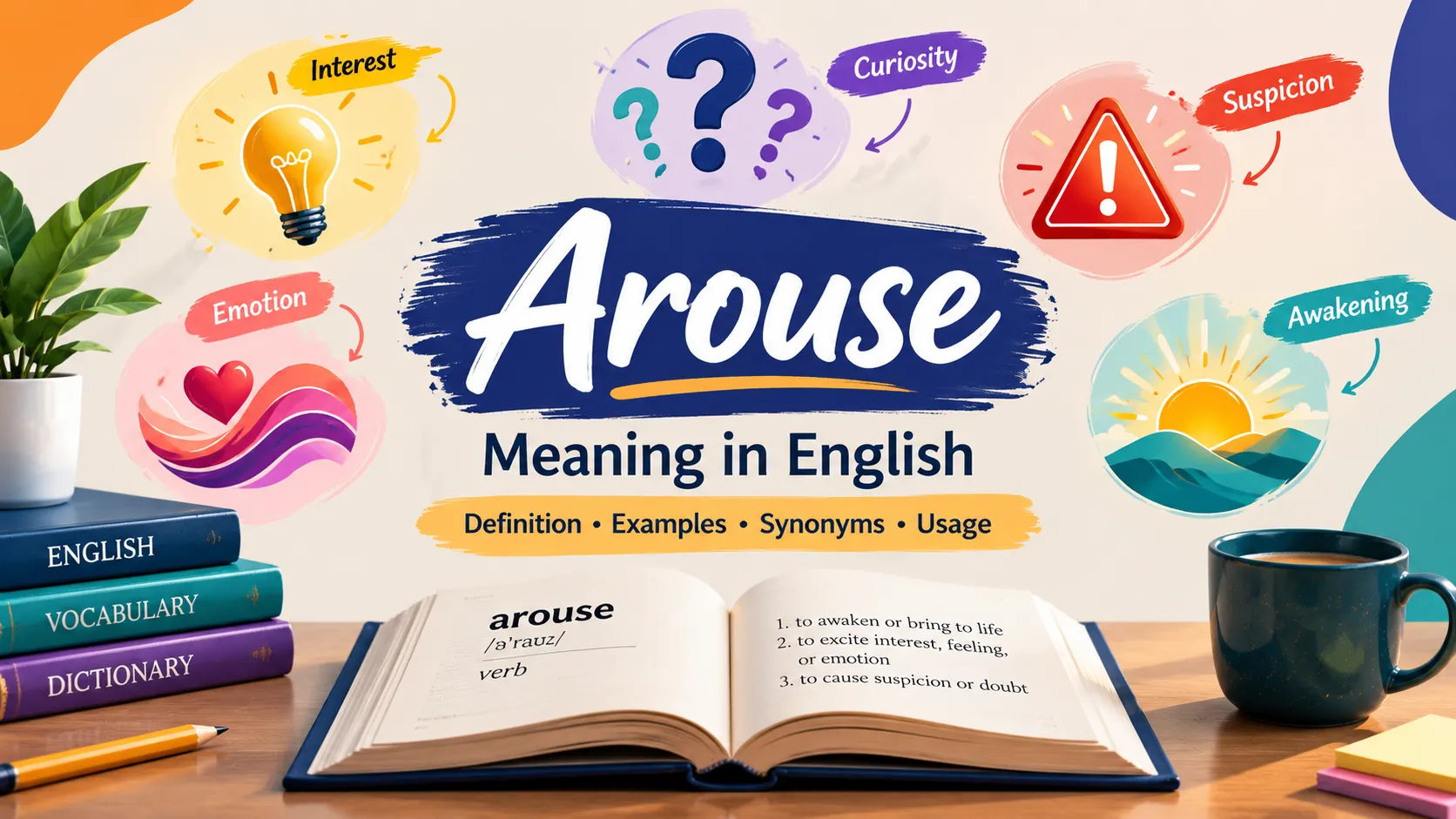
Arouse is a versatile English verb with several meanings depending on context. It can describe creating a feeling, reaction, interest, curiosity, or excitement.
- Arouse means to cause a particular feeling or reaction in someone.
- Arouse can mean to make someone interested in something.
- Arouse can describe creating curiosity about a person, idea, or situation.
- Arouse can mean to cause suspicion through unusual behavior.
- Arouse may describe causing anger or other strong emotions.
- Arouse can mean to stimulate someone to take action.
- Arouse can describe awakening someone from sleep.
- Arouse can also refer to creating excitement in a specific context.
- The meaning of arouse depends strongly on the words surrounding it.
- Arouse curiosity means to make someone curious.
- Arouse suspicion means to make someone suspicious.
- Arouse interest means to make someone interested.
- Arouse emotions means to cause strong feelings.
- Arouse someone to action means to motivate someone to act.
- Arouse does not always have a sexual meaning.
Arouse Meaning in Simple English
In simple English, arouse means to make a feeling, reaction, interest, or response begin or become stronger. The exact meaning changes according to the context.
- Arouse can simply mean to cause something to happen emotionally.
- Arouse interest means to make someone interested.
- Arouse curiosity means to make someone want to know more.
- Arouse suspicion means to make someone think something may be wrong.
- Arouse anger means to make someone angry.
- Arouse concern means to make someone worried.
- Arouse excitement means to create an excited feeling.
- Arouse emotion means to bring out strong feelings.
- Arouse action means to encourage someone to respond.
- Arouse from sleep means to wake someone.
- Arouse can mean stimulate in many contexts.
- Arouse can mean awaken when discussing feelings or awareness.
- Arouse can mean provoke when describing a strong reaction.
- Arouse can mean excite in certain situations.
- The easiest way to understand arouse is to awaken or cause a response.
Arouse Pronunciation and Word Forms
Learning the pronunciation and different forms of arouse makes it easier to recognize and use the word correctly. The main forms are arouse, arouses, aroused, and arousing.
- Arouse is pronounced approximately as uh-ROUZ.
- The pronunciation of arouse is /əˈraʊz/.
- Arouse is a verb.
- Arouses is the third-person singular present form.
- Aroused is the simple past form.
- Aroused is also used as the past participle.
- Arousing is the present participle or -ing form.
- I arouse uses the base form.
- She arouses uses the third-person singular form.
- They aroused describes something that happened in the past.
- The story is arousing. Curiosity uses the -ing form.
- Arousal is the related noun in some contexts.
- Correct word forms help avoid common grammar mistakes.
- The meaning can change slightly depending on the form and context.
- Knowing all forms makes everyday English usage easier.
Arouse Meaning in Different Contexts
The meaning of arouse changes according to the situation and the word that follows it. Context is the key to understanding which sense the speaker intends.
- Arouse interest means to create interest in something.
- Arouse curiosity means to make someone curious.
- Arouse suspicion means to create doubt or suspicion.
- Arouse anger means to cause anger.
- Arouse concern means to create worry.
- Arouse emotions means to produce strong feelings.
- Arouse excitement means to create excitement.
- Arouse passion means to awaken a strong feeling.
- Arouse controversy means to cause public disagreement.
- Arouse sympathy means to create feelings of compassion.
- Arouse someone to action means to motivate them.
- Arouse awareness means to make people more conscious of something.
- Arouse from sleep means to wake someone.
- Arouse can have a sexual meaning in specific contexts.
- The surrounding words usually reveal the intended meaning.
Arouse Interest and Curiosity
One of the most common non-sexual uses of arouse involves interest and curiosity. Writers often use it when something makes people want to learn, discover, or understand more.
- The mystery aroused everyone’s curiosity.
- The documentary aroused public interest.
- Her unusual story aroused my curiosity.
- The discovery aroused interest among scientists.
- The question aroused everyone’s interest.
- The unusual painting aroused curiosity among visitors.
- The announcement aroused considerable interest.
- The subject aroused my desire to learn more.
- The book aroused an interest in history.
- The mystery aroused questions among readers.
- The photograph aroused curiosity online.
- The new idea aroused interest among students.
- The investigation aroused public curiosity.
- The strange event aroused everyone’s attention and interest.
- A powerful question can arouse curiosity without giving away the answer.
Arouse Suspicion, Anger, and Strong Emotions
Arouse can describe the beginning of powerful emotional reactions. It commonly appears with words such as suspicion, anger, concern, fear, and emotion.
- His unusual behavior aroused suspicion.
- The decision aroused public anger.
- The report aroused serious concern.
- The injustice aroused strong emotions.
- The evidence aroused suspicion among investigators.
- The unfair treatment aroused anger.
- The story aroused feelings of sympathy.
- The announcement aroused concern among parents.
- The controversy aroused Passionate reactions.
- The incident aroused fear in the community.
- The speech aroused strong emotions in the audience.
- The unexpected news aroused anxiety.
- The decision aroused criticism from the public.
- The situation aroused mixed feelings.
- The shocking discovery aroused widespread concern.

Arouse Someone to Action or Response
In some contexts, arouse means to stimulate or motivate someone to respond. It suggests that a feeling or situation becomes strong enough to encourage action.
- The speech aroused the crowd to action.
- The crisis aroused people to demand change.
- The campaign aroused public support.
- The message aroused volunteers to help.
- The injustice aroused people to speak out.
- The warning aroused everyone to take precautions.
- The problem aroused the community to respond.
- The story aroused readers to think differently.
- The situation aroused concern and encouraged action.
- The leader’s words aroused people to participate.
- The campaign aroused citizens to become involved.
- The evidence aroused investigators to look deeper.
- The crisis aroused a strong desire for change.
- The message aroused people to reconsider their choices.
- A powerful idea can arouse people to meaningful action.
Arouse Meaning: When Waking From Sleep
Arouse can also mean to wake someone from sleep. This meaning is correct, although everyday English usually prefers “wake” or “wake up.”
- The loud noise aroused the sleeping child.
- The storm aroused us from our sleep.
- The sudden sound aroused everyone in the room.
- The alarm aroused him before sunrise.
- The barking dog aroused the family.
- The thunder aroused the baby.
- The strange noise aroused her from sleep.
- The disturbance aroused the sleeping guests.
- The explosion aroused everyone nearby.
- The ringing phone aroused him from a deep sleep.
- The cold air aroused the sleeping traveler.
- The unexpected sound aroused the entire household.
- The commotion aroused the children.
- The early morning noise aroused the Neighborhood.
- In everyday speech, woke up is usually more natural than aroused.
Arouse Meaning in a Sexual Context
Arouse can have a sexual meaning when the context specifically refers to sexual excitement or stimulation. However, this is only one meaning of the word.
- Arouse can describe causing sexual excitement.
- Sexual arousal refers specifically to sexual excitement or response.
- The context determines whether arouse has a sexual meaning.
- Arouse curiosity has no sexual meaning.
- Arouse suspicion has no sexual meaning.
- Arouse anger has no sexual meaning.
- Arouse interest normally refers to general interest.
- Sexually aroused clearly identifies the sexual context.
- The word should not automatically be interpreted sexually.
- Dictionary definitions include both general and sexual senses.
- Surrounding words provide important clues about meaning.
- Formal writing may use arouse for many non-sexual reactions.
- English learners should always consider the complete sentence.
- Context prevents misunderstandings about the word.
- Arouse is a broader word than its sexual meaning alone suggests.
Arouse Meaning in Urdu and Roman Urdu
The Urdu meaning of arouse changes with context because English does not have one fixed Urdu translation for every use. It can relate to awakening, stimulation, emotion, interest, suspicion, or action.
- Arouse can mean in the sense of waking someone.
- Arouse can mean causing a feeling or reaction.
- Arouse can mean stimulating someone.
- Arouse can mean provoking a response.
- Arouse interest can mean.
- Arouse curiosity can mean.
- Arouse suspicion can mean.
- Arouse anger can mean.
- Arouse emotion can mean.
- Arouse someone can sometimes mean.
- Roman Urdu for arouse can be jagana.
- Roman Urdu can also use ubharna for emotional reactions.
- Dilchaspi paida karna fits the interest meaning.
- Shak paida karna fits the suspicion meaning.
- The best Urdu translation depends on the sentence.
Arouse Meaning in Hindi and Roman Hindi
In Hindi, arouse can have several translations depending on the intended meaning. Understanding the context helps you choose the most natural Hindi expression.
- Arouse can mean when referring to sleep.
- Arouse can mean something in specific contexts.
- Arouse can mean when discussing emotions.
- Arouse interest can mean.
- Arouse curiosity can mean
- Arouse suspicion can mean.
- Arouse anger can mean.
- Arouse emotions can mean.
- Roman Hindi for jagana is commonly used for the waking sense.
- Ruchi paida karna fits the interest meaning.
- Jigyasa jagana fits the curiosity meaning.
- Sandeh paida karna fits the suspicion meaning.
- Bhavna jagana fits emotional contexts.
- The correct translation depends on the surrounding sentence.
- A single Hindi translation cannot cover every meaning of arouse.
Related to Other Article: https://blesssprout.com/christmas-blessings/
Arouse Examples in Sentences
The easiest way to understand arouse is to see how native English uses it in different contexts. These examples show why the meaning should always be interpreted from the sentence.
- The book aroused my curiosity.
- His behavior aroused suspicion.
- The announcement aroused public interest.
- The speech aroused strong emotions.
- The decision aroused public anger.
- The mystery aroused everyone’s curiosity.
- The documentary aroused interest in history.
- The news aroused concern among residents.
- The incident aroused widespread controversy.
- The campaign aroused people to action.
- The story aroused sympathy for the character.
- The unusual evidence aroused suspicion.
- The loud noise aroused the sleeping child.
- The topic aroused a passionate response.
- The subject can arouse different reactions in different people.
Arouse Synonyms and Antonyms
The best synonym for arouse depends on what you want to express. Words such as stimulate, provoke, evoke, awaken, stir, and excite overlap with arouse but are not always interchangeable.
- Stimulate can mean to encourage activity or interest.
- Provoke often means to cause a strong reaction.
- Evoke means to bring a feeling, memory, or response to mind.
- Awaken can mean to bring a feeling or awareness to life.
- Stir can mean to awaken strong emotions.
- Inspire can mean to create motivation or enthusiasm.
- Kindle can mean to start or strengthen a feeling.
- Excite can mean to create enthusiasm or excitement.
- Rouse can mean to wake or motivate someone.
- Spark can mean to start an idea, feeling, or reaction.
- Calm can be the opposite of arouse when discussing anger.
- Soothe can oppose arouse when referring to strong emotions.
- Suppress can oppose arouse when a feeling is being held back.
- Discourage can oppose arouse when referring to interest or motivation.
- The correct synonym or antonym depends on the context.
Arouse vs Rouse: What Is the Difference?
Arouse and rouse look and sound similar, but their common uses are different. Understanding the distinction can help English learners avoid confusing these two verbs.
- Arouse commonly means to cause a feeling or reaction.
- Rouse commonly means to wake someone.
- Arouse curiosity means to make someone curious.
- Rouse someone from sleep means to wake them.
- Arouse suspicion means to make someone suspicious.
- Rouse the crowd means to stir the crowd into action.
- Arouse interest focuses on creating interest.
- Rouse people to action focuses on motivating them.
- The story aroused curiosity sounds natural.
- The alarm roused me from sleep sounds natural.
- Both words can involve awakening in different senses.
- Arouse often connects with feelings and reactions.
- Rouse often connects with sleep and action.
- Context determines which word works best.
- Remember: arouse a feeling, rouse a person to action.
Related to Other Article: https://blesssprout.com/arousal-synonym/
Arouse vs Excite: What Is the Difference?
The choice depends on the type of feeling or reaction being described.
- Excite commonly means to make someone enthusiastic or excited.
- Arouse often means to cause a particular reaction or feeling.
- Arouse curiosity is more natural than excite curiosity.
- Arouse suspicion is more natural than excite suspicion.
- Arouse concern clearly means to cause concern.
- Excite children can mean to make children enthusiastic.
- Arouse interest means to create interest.
- Excite interest can sound less natural in many contexts.
- Arouse anger means to cause anger.
- Excite can suggest enthusiasm or anticipation.
- Arouse can suggest an emotional or psychological response.
- Both words can overlap when describing excitement.
- Both can have sexual meanings in specific contexts.
- Context determines which word sounds most natural.
- Arouse is broader when describing different types of reactions.
People Also Ask
A: Arouse means to cause a feeling, reaction, interest, excitement, or response. It can also mean to wake someone from sleep or cause sexual excitement.
A: It means to cause someone to experience a particular feeling or reaction. Depending on context, it can also mean waking someone or causing sexual excitement.
A: It can have a sexual meaning, but it is not always sexual. Expressions such as arouse curiosity and arouse suspicion are completely non-sexual.
A: Arouse commonly means to cause a feeling or reaction, while rouse commonly means to wake someone or stir someone into action.
A: Depending on context, synonyms include stimulate, provoke, evoke, awaken, stir, inspire, kindle, excite, and rouse.
Conclusion
Understanding the meaning in English becomes much easier when you look at the context instead of memorizing only one definition. The word can mean to cause a feeling, create interest or curiosity, produce a reaction, motivate someone to act, or wake someone from sleep. In a specific context, it can also refer to sexual excitement.
The easiest way to remember it is: arouse means to awaken, stimulate, provoke, or cause something to happen or be felt. Whether you are reading, writing, or learning English, paying attention to the words around “arouse” will help you understand its exact meaning.
Keep this guide bookmarked whenever you need a quick Reference for arouse synonyms, examples, pronunciation, Urdu and Hindi meanings, or common usage differences.











2 thoughts on “Arouse Meaning in English: Definition, Uses & Examples Guide ”