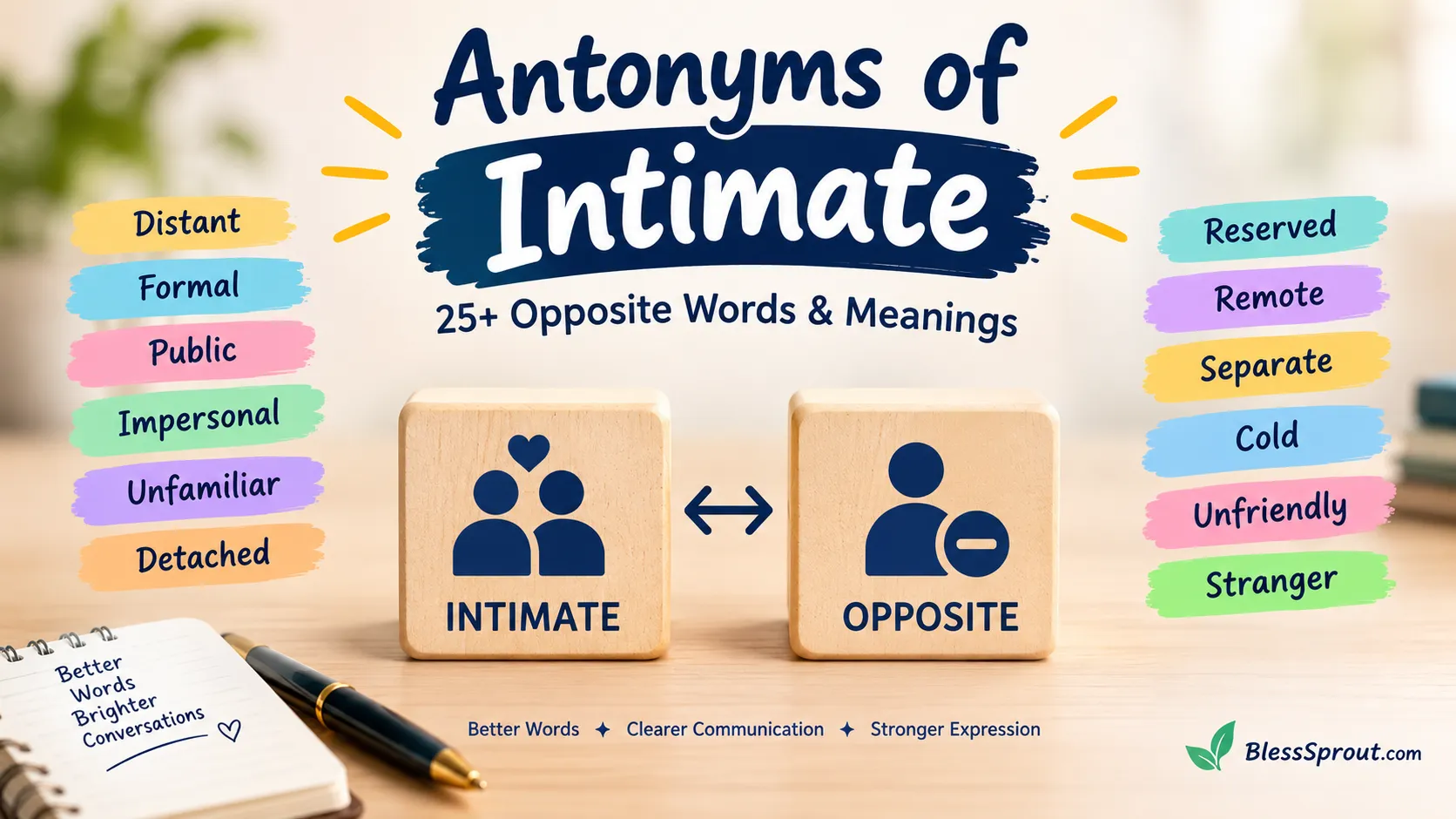
225+ Opposite Words, Meanings & Examples
Finding the right antonyms of intimate depends on what intimate means in your sentence. It can Describe emotional closeness, privacy, familiarity, personal communication, or even a close friend.
The sections below organize the most useful opposites by context so you can quickly choose a word that sounds natural and accurate.
Distant as an Antonym of Intimate
Distant is one of the clearest opposites when intimate describes an emotionally or socially close relationship.
- Their once-intimate friendship became distant over time.
- She seemed distant after the disagreement.
- Their relationship remained distant and formal.
- He maintained a distant attitude toward his coworkers.
- The two friends slowly became distant.
- Their emotional connection felt distant.
- She kept a distant relationship with her former colleagues.
- His distant behavior surprised everyone.
- They grew distant after moving to different cities.
- The conversation felt distant rather than personal.
- Their connection became distant after years apart.
- He appeared distant during the family gathering.
- She noticed his increasingly distant attitude.
- Their once-close bond now felt distant.
- A distant relationship lacks the closeness of an intimate one.
Formal as an Antonym of Intimate
Formal works best when intimate describes a personal, relaxed, or familiar interaction.
- Their first conversation was formal rather than intimate.
- The meeting remained formal throughout the afternoon.
- His message sounded formal and professional.
- They maintained a formal relationship at work.
- Her tone became more formal during the meeting.
- The discussion stayed formal and respectful.
- Their communication was polite but formal.
- He used a formal greeting with the new client.
- The event created a formal atmosphere.
- Their interaction remained formal because they had just met.
- She preferred a formal tone for the announcement.
- The conversation moved from intimate to formal.
- His writing style sounded formal rather than personal.
- They kept their Professional relationship formal.
- A formal exchange usually feels less personal than an intimate one.
Impersonal as an Antonym of Intimate
Impersonal contrasts with intimate when the focus is personal warmth, individuality, or emotional involvement.
- The email sounded impersonal rather than intimate.
- His response was polite but impersonal.
- The message felt brief and impersonal.
- Their communication became increasingly impersonal.
- The office atmosphere felt professional and impersonal.
- Her writing style was clear but impersonal.
- The announcement used an impersonal tone.
- His answer sounded factual and impersonal.
- The conversation remained impersonal throughout.
- The automated reply felt completely impersonal.
- Their relationship became more distant and impersonal.
- The letter lacked the intimate warmth of a personal message.
- The formal statement sounded impersonal.
- She avoided intimate details and kept her response impersonal.
- An impersonal tone minimizes personal connection.
Public as an Antonym of Intimate
When intimate means private or personal, public becomes a strong contextual opposite.
- The intimate details eventually became public.
- She kept her personal life private rather than making it public.
- The discussion moved from an intimate setting to a public forum.
- Their private conversation became a public discussion.
- The information was once private but is now public.
- She did not want intimate details to become public.
- The event changed from a private gathering into a public celebration.
- His personal statement quickly became public.
- The announcement turned a private matter into a public issue.
- They moved the conversation into a public space.
- The intimate setting contrasted with the busy public venue.
- She separated her private life from her public image.
- The information was no longer confidential or intimate.
- The public announcement revealed previously private details.
- Public information lacks the privacy associated with intimate information.

Unfamiliar as an Antonym of Intimate
Unfamiliar works when intimate means deeply familiar, well known, or personally acquainted.
- The new city felt unfamiliar to him.
- She felt uncomfortable around unfamiliar people.
- The subject was unfamiliar to the students.
- His surroundings seemed unfamiliar at first.
- They remained unfamiliar with each other’s habits.
- The new environment felt distant and unfamiliar.
- She entered an unfamiliar workplace.
- The topic was completely unfamiliar to me.
- He struggled to understand the unfamiliar customs.
- Their relationship remained unfamiliar rather than intimate.
- The neighborhood was unfamiliar to the visitors.
- She found herself surrounded by unfamiliar faces.
- The new situation felt unfamiliar and uncertain.
- They were still Unfamiliar with one another.
- Unfamiliar describes a lack of personal knowledge or familiarity.
Detached as an Antonym of Intimate
Detached is useful when you want to describe a lack of emotional involvement.
- He remained detached during the discussion.
- She seemed emotionally detached from the situation.
- His detached attitude surprised everyone.
- They became detached after years of disagreement.
- She tried to remain detached from the conflict.
- His response sounded calm but detached.
- The character appeared emotionally detached.
- He kept a detached attitude toward the criticism.
- Their relationship felt increasingly detached.
- She sounded detached while discussing the problem.
- The conversation lacked the warmth of an intimate exchange.
- His detached behavior created emotional distance.
- She remained detached instead of becoming personally involved.
- The relationship felt detached rather than connected.
- Detached emphasizes emotional separation rather than simple physical distance.
Reserved as an Antonym of Intimate
Reserved describes someone who does not readily reveal personal thoughts, feelings, or information.
- She was friendly but reserved around strangers.
- He remained reserved during the conversation.
- Her reserved personality made her difficult to read.
- He became more reserved around new people.
- She kept her feelings private and remained reserved.
- His reserved nature contrasted with her openness.
- The quiet student appeared reserved but polite.
- He was naturally reserved in social situations.
- She gave a reserved response to the personal question.
- His manner was respectful but reserved.
- She remained reserved instead of sharing personal details.
- The new employee seemed friendly yet reserved.
- His reserved personality limited Emotional openness.
- She kept a reserved attitude throughout the meeting.
- Reserved suggests restraint rather than complete emotional distance.
Remote as an Antonym of Intimate
Remote can describe physical distance, emotional distance, or a lack of close connection.
- The village was remote and difficult to reach.
- He seemed emotionally remote during the discussion.
- Their relationship became remote over time.
- The location was too remote for regular visits.
- She felt remote from her former friends.
- His remote attitude made conversation difficult.
- The two communities remained geographically remote.
- Their connection felt increasingly remote.
- He appeared remote and emotionally unavailable.
- The remote location created physical separation.
- Their lives became remote from each other.
- She maintained a remote relationship with the group.
- The setting was peaceful but extremely remote.
- His behavior seemed distant and remote.
- Remote emphasizes separation more strongly than simple unfamiliarity.
Cold and Unfriendly as Opposites of Intimate
Cold and unfriendly can contrast with intimate when the focus is warmth, affection, or personal connection.
- His response sounded cold rather than personal.
- She became cold after the disagreement.
- The atmosphere felt cold and uncomfortable.
- His behavior seemed unfriendly toward the guests.
- The receptionist gave an unfriendly response.
- Their interaction became cold over time.
- He appeared cold despite being polite.
- The conversation felt unfriendly and distant.
- She noticed a cold change in his attitude.
- Their once-warm relationship became cold.
- The new environment seemed unfriendly.
- His cold response created emotional distance.
- The group appeared unfriendly toward newcomers.
- Their communication lacked warmth and became cold.
- Cold and unfriendly are stronger contrasts when emotional warmth matters.
Stranger, Outsider, Enemy, and Foe as Antonyms of Intimate
When intimate functions as a noun meaning a close friend or trusted associate, different opposites become relevant.
- A stranger is someone you do not know personally.
- An outsider belongs outside a particular group.
- An enemy actively opposes another person.
- A foe is a formal or literary term for an opponent.
- He was a stranger rather than a trusted intimate.
- She felt like an outsider in the unfamiliar group.
- His former ally eventually became an enemy.
- The hero confronted his strongest foe.
- The new neighbor was still a stranger to them.
- She entered the community as an outsider.
- The former friend became an enemy after the dispute.
- The fictional hero faced a powerful foe.
- A stranger lacks the familiarity of an intimate.
- An outsider lacks the belonging associated with a close group.
- An enemy or foe expresses opposition rather than simple distance.
Related to Other Article: https://blesssprout.com/special-beautiful-good-morning-sunday/
Intimate vs Distant, Formal, Public, and Impersonal
These four comparisons cover some of the most common uses of intimate.
- Intimate means close, while distant means separated.
- Intimate relationships involve personal connection.
- Distant relationships involve limited emotional closeness.
- Intimate conversations feel personal and familiar.
- Formal conversations follow professional or official conventions.
- Intimate information is personal or private.
- Public information is open or accessible to others.
- Intimate communication emphasizes personal involvement.
- Impersonal communication minimizes personal involvement.
- Distant describes separation rather than necessarily hostility.
- Formal describes style rather than necessarily emotional distance.
- Public describes accessibility rather than relationship closeness.
- Impersonal describes a lack of personal quality.
- These words should not be treated as universal replacements.
- The sentence context determines the strongest opposite.
Examples of Antonyms of Intimate in Sentences
These examples show how different antonyms work naturally in everyday English.
- Their relationship became distant after the disagreement.
- The meeting remained formal from beginning to end.
- His message sounded impersonal.
- The private information eventually became public.
- The unfamiliar surroundings made her nervous.
- He remained emotionally detached from the situation.
- She was friendly but reserved.
- The two groups stayed separate.
- His response sounded unusually cold.
- The village was extremely remote.
- The new neighbors seemed unfriendly.
- She felt like an outsider in the community.
- He was a stranger to me.
- Their conversation remained superficial.
- The two friends gradually became disconnected.
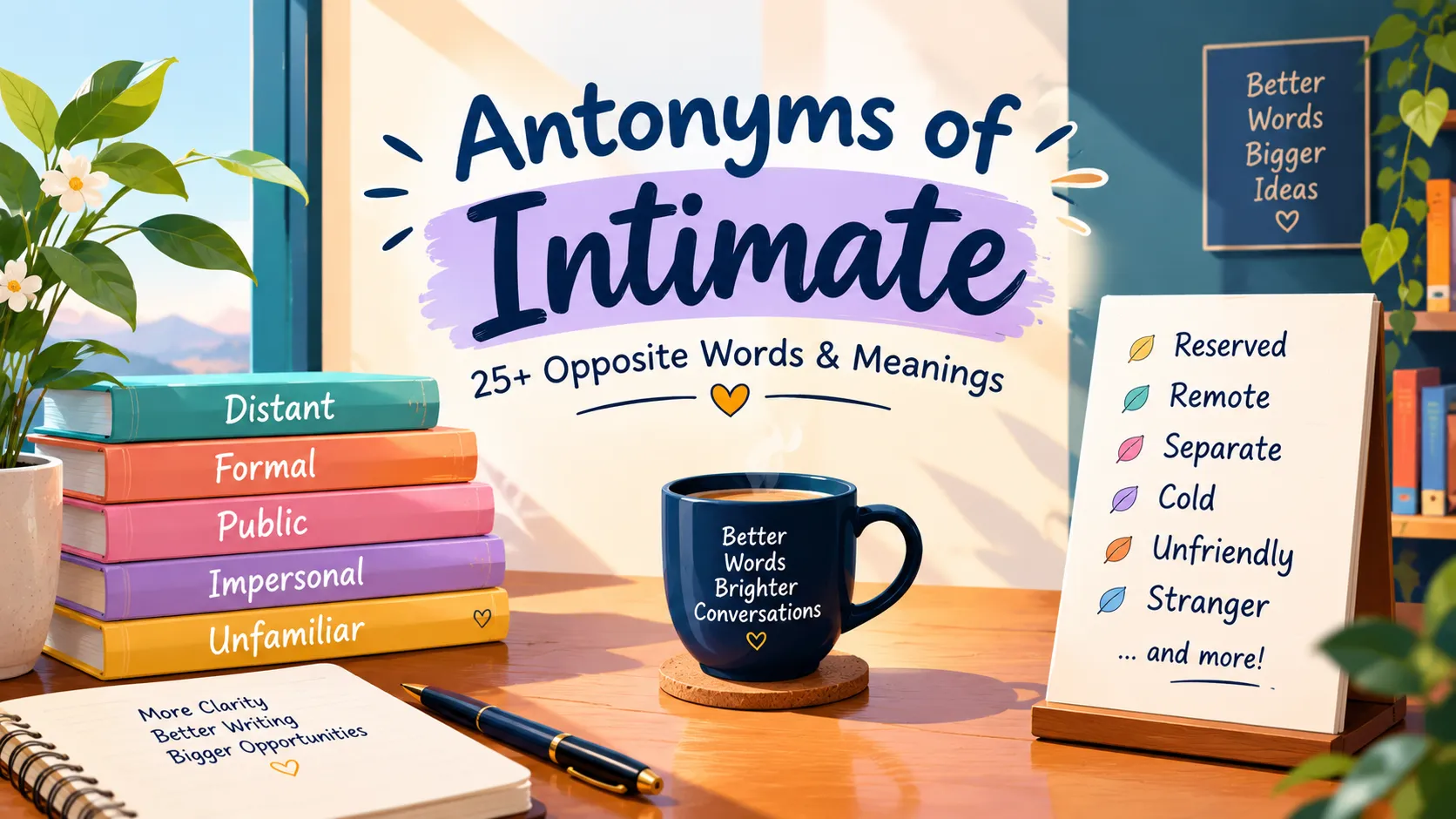
Antonyms of Intimate as an Adjective, Noun, and Verb
The word intimate changes meaning depending on how you use it in a sentence.
- As an adjective, intimate can mean close or personal.
- As an adjective, distant can contrast with emotional closeness.
- As an adjective, formal can contrast with personal interaction.
- As an adjective, public can contrast with privacy.
- As an adjective, impersonal can contrast with personal communication.
- As an adjective, unfamiliar can contrast with deep familiarity.
- As an adjective, detached can contrast with emotional involvement.
- As a noun, an intimate can mean a close friend.
- A stranger can contrast with an intimate in the noun sense.
- An outsider can describe someone outside a close group.
- An enemy can describe someone who actively opposes another person.
- A foe can describe an opponent in formal or literary language.
- As a verb, intimate can mean to hint or suggest.
- State and declare can contrast with the verb sense of intimate.
- Understanding the part of speech helps you choose the correct antonym.
Related to Other Article: https://blesssprout.com/another-word-for-horny/
People Also Ask
A: The most common opposite is distant, especially when intimate describes emotional or social closeness. Other context-dependent opposites include formal, remote, impersonal, public, unfamiliar, detached, and reserved.
A: Depending on the context, you can use distant, formal, impersonal, detached, unfamiliar, remote, reserved, or separate.
A: Yes. Distant is a strong antonym when intimate refers to emotional, social, or personal closeness. It is not the best opposite for every meaning.
A: Yes, formal can contrast with intimate when the word describes a personal, familiar, or informal interaction.
A: Possible contrasts include a distant, detached, unfamiliar, impersonal, or strained relationship, depending on the specific meaning.
Conclusion
The best antonyms of intimate depend on the meaning and context of the sentence. Distant works well for emotional or social separation, while formal suits professional interactions. Impersonal describes communication without personal warmth, and Public contrasts with intimate information when privacy is the focus.
Other useful opposites include unfamiliar, detached, reserved, remote, separate, cold, unfriendly, superficial, stranger, and outsider. Choosing the right word based on context helps you communicate your exact meaning more clearly and naturally.










1 thought on “Antonyms of Intimate: 25+ Opposite Words & Meanings”