Introduction
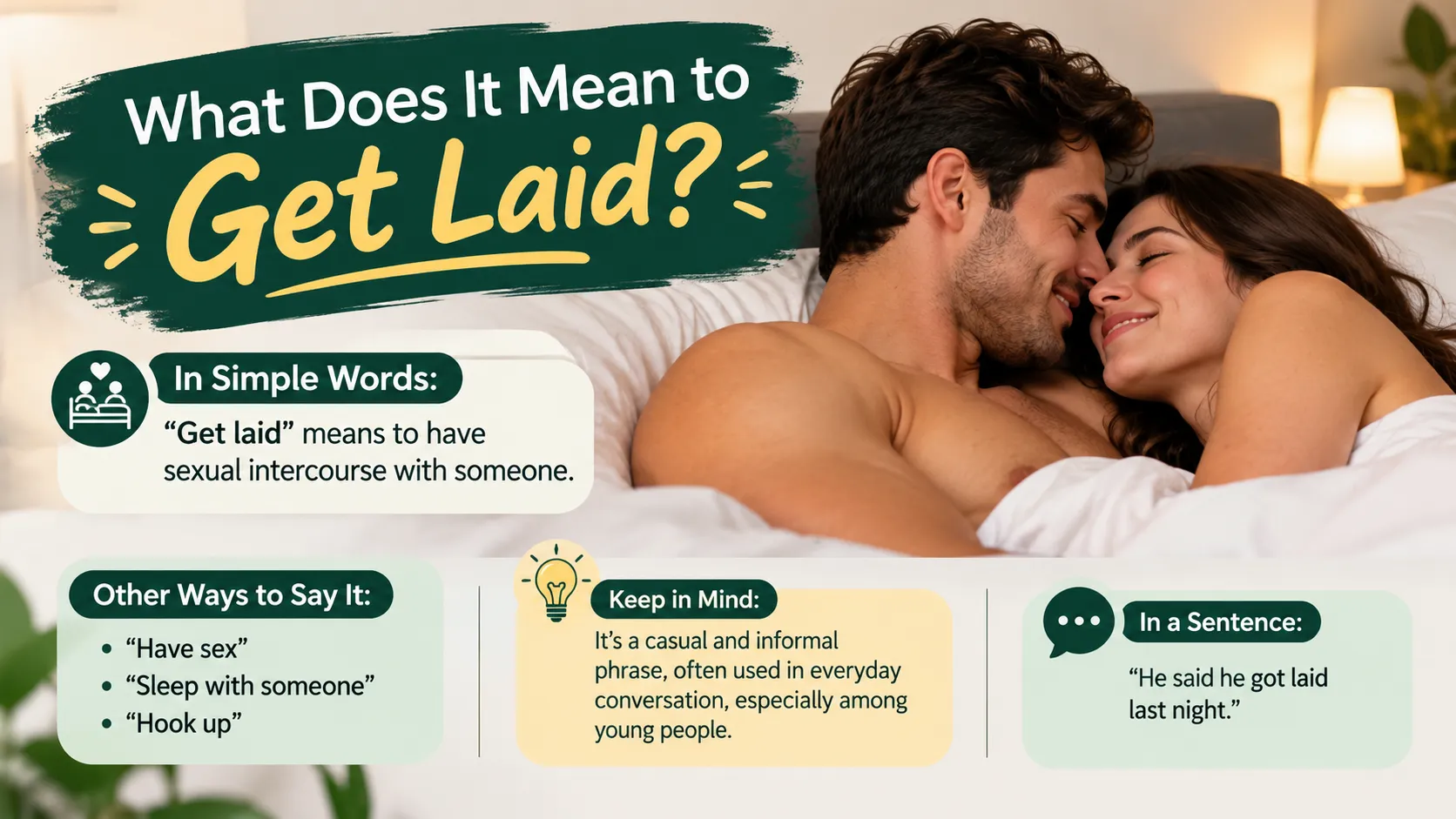
What does it mean to get laid? The Phrase is casual and can sometimes sound humorous, blunt, or disrespectful depending on the context.
This guide explains the phrase’s meaning, origin, tone, common examples, related expressions, and everyday usage. We’ll also look at when it may be appropriate—or inappropriate—to use it.
“Get Laid” Slang Meaning Explained
“Get laid” is not a formal expression. It belongs to informal, slang-heavy English and is more common in casual conversations, entertainment, and online communication.
- It is more casual than have sex.
- It can sound blunt in conversation.
- It can sometimes sound vulgar.
- Friends may use it jokingly.
- Movies often use the phrase in casual dialogue.
- Online conversations may use it as slang.
- It is generally unsuitable for formal writing.
- The phrase can sound crude in some situations.
- Its meaning depends on conversational context.
- It can describe someone’s sexual goal.
- It does not automatically imply romance.
- It does not automatically imply love.
What “Trying to Get Laid” Means
It can be serious, humorous, sarcastic, or judgmental.
- He’s trying to have sex.
- She’s trying to have sex.
- They think he’s trying to have sex.
- His friends joked that he was trying to have sex.
- She said he was only trying to have sex.
- He seems more interested in having sex.
- They accused him of trying to have sex.
- He’s openly trying to have sex.
- She thinks he’s trying to have sex.
- His friends teased him about trying to have sex.
- He admitted he was trying to have sex.
- She joked that everyone was trying to have sex.
- The character was clearly trying to have sex.
- He wasn’t looking for romance; he was trying to have sex.
- “The phrase suggests that sex is the person’s immediate goal.”
“Get Laid” in Everyday Conversation
The phrase is most likely to appear in casual conversations about dating, relationships, sex, or someone’s personal life. The same words can sound different depending on the surrounding conversation.
- He keeps talking about having sex.
- They were joking about having sex.
- His friends teased him about having sex.
- She said he only wanted to have sex.
- The movie character wanted to have sex.
- He joked that he hadn’t had sex recently.
- They started talking about dating and having sex.
- His friends laughed when he mentioned having sex.
- She called his behavior an attempt to have sex.
- He made a joke about trying to have sex.
- “They used the phrase casually among friends.”
- The conversation became awkward after he mentioned having sex.
- “He used the slang expression without thinking.”
- “She understood what he meant immediately.”
- “The phrase sounded too blunt for the situation.”

“Get Laid” Examples in Simple English
These examples show how the expression can appear naturally in sentences. They are useful for learners who want to understand sentence structure as well as meaning.
- He wants to have sex.
- She doesn’t want to have sex.
- He’s trying to have sex.
- I had sex last weekend.
- They were talking about having sex.
- He joked about having sex.
- She said he was trying to have sex.
- His friends teased him about having sex.
- The character wanted to have sex.
- He admitted that he wanted to have sex.
- She thought he was only trying to have sex.
- They laughed about the phrase.
- He used the expression casually.
- She understood the slang Immediately.
- The phrase is common in informal English.
What “Getting Laid” Means in Texting
However, the tone may be playful, serious, sarcastic, or judgmental.
- Are you trying to have sex?
- He’s just trying to have sex.
- She thinks he’s trying to have sex.
- They were joking about having sex.
- I haven’t had sex in a while.
- He keeps talking about having sex.
- Why does he keep talking about having sex?
- They were texting about dating and having sex.
- He joked about wanting to have sex.
- She didn’t like the way he talked about having sex.
- He used the phrase as a joke.
- The message was clearly informal.
- The phrase can sound blunt even in a text.
“Get Laid” Meaning in Dating Conversations
In dating conversations, the phrase often emphasizes sexual interest rather than romantic commitment. Still, the phrase itself does not prove what someone’s actual intentions are.
- He’s dating because he wants to have sex.
- She thinks he’s only trying to have sex.
- They talked about whether he wanted romance or sex.
- She didn’t want someone who only wanted sex.
- He made it clear that he wanted more than just sex.
- The conversation focused on dating intentions.
- They discussed whether the relationship was serious.
- She wondered whether he wanted romance or sex.
- He seemed more interested in physical intimacy.
- She thought his intentions were mainly sexual.
- They were trying to Understand his dating goals.
- The phrase can suggest a short-term sexual goal.
- Context determines whether the phrase sounds critical or casual.
Is “Get Laid” Rude or Vulgar?
In some settings, it can sound crude, blunt, or inappropriate.
- It can sound casual among close friends.
- It can sound vulgar in formal settings.
- It may sound humorous in comedy.
- It can sound blunt in dating conversations.
- It may seem inappropriate at work.
- It is generally unsuitable for academic writing.
- It can sound crude around unfamiliar people.
- Friends may use it without intending offense.
- Some listeners may dislike the expression.
- The surrounding conversation can change its impact.
- A joke can make the phrase sound less serious.
- A serious statement can make it sound more direct.
- A professional audience may find it inappropriate.
- Having sex is usually a safer, neutral alternative.
Get Laid vs. Have Sex
Both expressions refer to the same basic activity, but their register and tone are different.
- I had sex sounds neutral.
- I got laid sounds slang-heavy.
- They had sex sounds straightforward.
- Have sex works in general conversation.
- Sexual intercourse sounds clinical.
- Be intimate can sound softer.
- Formal writing usually favors neutral language.
- Casual speech allows more slang.
- English learners should understand both registers.
- The definition may overlap while the tone differs.
- Having sex is easier to use safely.
- Context determines which expression works best.
Related to Other Article: https://blesssprout.com/good-evening-blessings-2/

Get Laid vs. Sleep With Someone
“Sleep with someone” is another expression that can refer to having sex.
- They slept together.
- He slept with someone.
- She slept with him.
- They decided to sleep together.
- He admitted that they slept together.
- She said they had slept together.
- Sleeping with someone can be euphemistic.
- Sleep with someone can sound less crude.
- Both expressions can refer to sex.
- Neither phrase automatically means love.
- Neither phrase automatically means commitment.
- Context determines the exact impression.
- Sleep with can sound more relationship-focused.
Related to Other Article: https://blesssprout.com/another-word-for-deliciousness/
People Also Ask
A: It is not usually classified as a swear word, but it is slang and can sound vulgar or crude depending on the context.
A: It means someone is trying to find an opportunity to have sex, often implying that sex is their immediate goal.
A: No. It is very informal slang and is generally unsuitable for formal writing or professional communication.
A: Yes. The expression can be used regardless of gender. Whether someone chooses to use it depends on their personal speaking style and the situation.
A: The basic meaning is similar, but the tone is different. “Have sex” is neutral, while “get laid” is slang and more blunt.
Conclusion
If you’re learning English, the key is to understand both the meaning and tone. “Have sex” is generally neutral, while “get laid” is much more informal. Similarly, “sleep with someone” and “hook up” can overlap in meaning but may carry different levels of ambiguity or tone.
Understanding these differences can help you recognize informal English naturally and choose the right expression for the situation.










1 thought on “What Does It Mean to Get Laid? Meaning, Slang & Examples”