Introduction
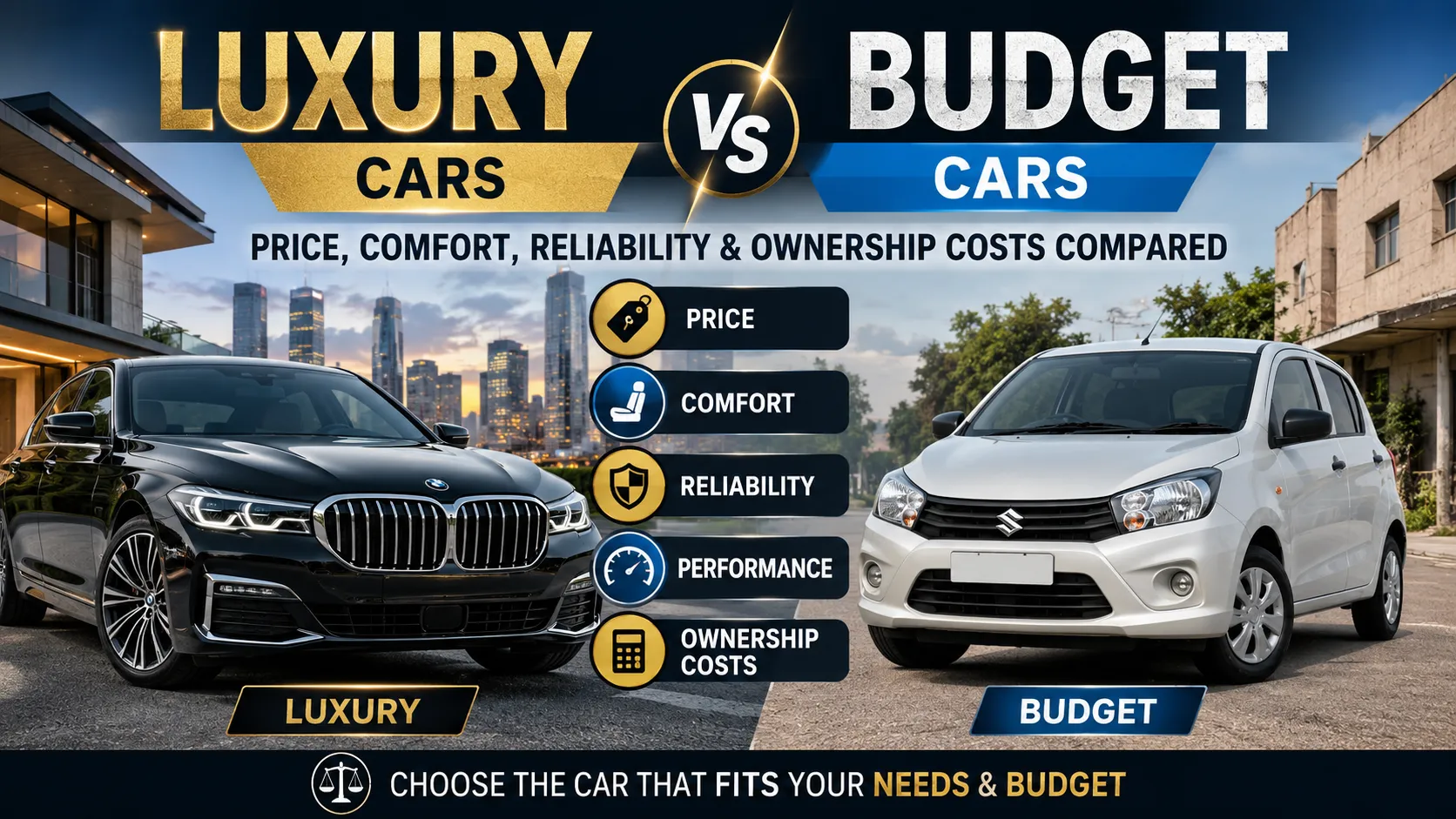
Choosing between a luxury car and a budget-friendly vehicle isn’t simply about asking which one is better.
The more useful question is:
That’s why the smartest way to approach luxury vs budget cars is to look beyond the badge.
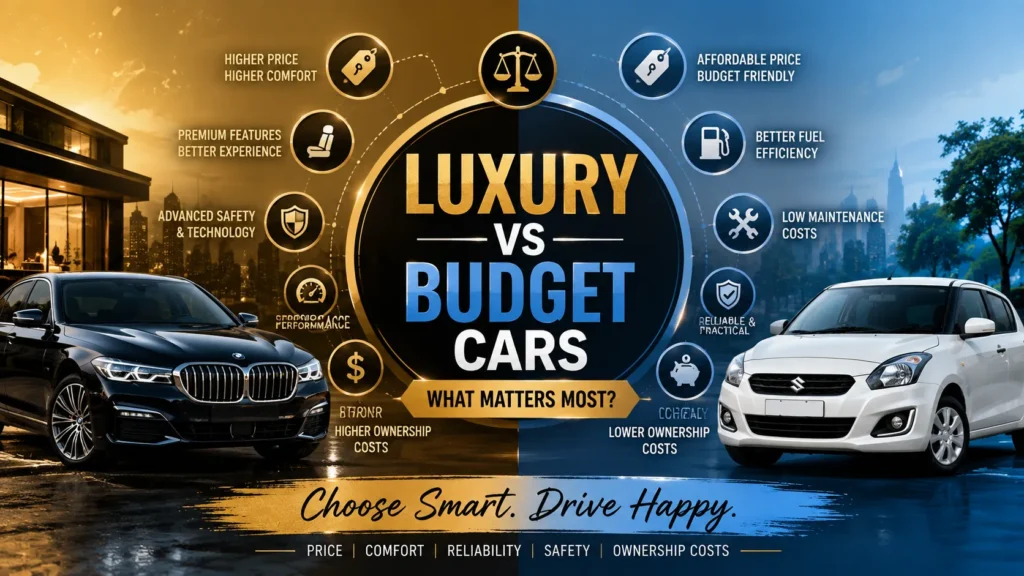
A luxury vehicle may offer a quieter cabin, premium materials, stronger performance, sophisticated technology, and a more refined driving experience. A budget or mainstream car may deliver lower running costs, better fuel economy, easier maintenance, and greater financial predictability.
What Matters Most When Comparing Luxury and Budget Cars?
Before comparing two vehicles, evaluate these factors:
- Purchase price
- Total cost of ownership
- Reliability
- Maintenance
- Repairs
- Depreciation
- Insurance
- Fuel economy
- Safety
- Comfort
- Technology
- Performance
- Warranty
- Resale value
- Lifestyle fit
Total Cost of Ownership: The Number You Should Actually Compare
Total cost of ownership, or TCO, gives you a much clearer picture.
A simplified calculation is:
Consider two hypothetical vehicles.
Budget Vehicle
- Lower purchase price
- Lower insurance
- Strong fuel economy
- Affordable parts
- Lower maintenance costs
Luxury Vehicle
- Higher purchase price
- Higher insurance
- More expensive components
- Potentially higher repair costs
- Greater comfort and performance
Maintenance and Repair Costs
Maintenance is one of the biggest areas where luxury and mainstream vehicles can diverge.
Luxury vehicles may use:
- Sophisticated suspension systems
- Complex electronics
- Turbocharged engines
- Premium braking components
- Specialized parts
- More expensive tires
- Advanced driver-assistance hardware
Those features can improve the driving experience but may also increase repair complexity.
Edmunds’ classic new-mainstream-versus-used-luxury comparison illustrated this difference particularly clearly, finding substantially higher maintenance and repair estimates for its older used-luxury example.
Reliability and Long-Term Ownership
Reliability should be one of your highest priorities.
A beautiful vehicle becomes frustrating when unexpected breakdowns repeatedly interrupt your life.
Before buying, research:
- Specific model year
- Engine
- Transmission
- Known mechanical problems
- Recalls
- Reliability history
- Maintenance schedule
- Parts availability
- Repair costs
Consumer Reports’ 2026 used-luxury coverage emphasizes exactly this point: some luxury models can deliver the comfort and performance buyers expect, while others can create expensive ownership Headaches once they are older and outside warranty coverage.
Depreciation Can Change the Entire Luxury vs Budget Debate
Depreciation is one of the most important—and most frequently overlooked—vehicle costs.
A new vehicle can lose a significant portion of its value during its early years.
This creates an interesting opportunity for used-car buyers.
- Premium materials
- Modern safety features
- Advanced technology
- Strong performance
- Comfortable seating
- Refined driving dynamics
That’s one reason used luxury can sometimes look attractive compared with buying a new mainstream vehicle.
Insurance Costs Matter More Than Many Buyers Expect
Insurance can significantly affect your annual ownership cost.
Luxury vehicles may have higher insurance costs because their:
- Replacement values can be higher
- Parts can be more expensive
- Sensors and electronics may be costly
- Repairs may require specialized labor
- Performance can affect premiums
But insurance varies by driver, location, insurer, vehicle, and coverage level.
Fuel Economy and Everyday Running Costs
Fuel economy becomes increasingly important as annual mileage increases.
If you drive 5,000 miles a year, a small fuel-economy difference may not matter much.
If you drive 20,000 miles annually, it can become a major expense.
Compare:
- MPG or energy consumption
- Fuel type
- Premium-fuel requirements
- Annual mileage
- Local fuel prices
- Hybrid efficiency
- EV charging costs
And don’t assume every luxury car is inefficient.
Modern hybrids, EVs, and highly efficient premium vehicles can challenge the traditional assumption that luxury automatically means high fuel consumption.
The correct comparison is always vehicle against vehicle.
Comfort and Interior Quality
This is where luxury vehicles often provide their clearest advantage.
A premium vehicle may offer:
- More supportive seats
- Better sound insulation
- Higher-quality materials
- Better climate systems
- Quieter highway driving
- More seat adjustments
- Superior ride quality
- Premium audio
- Better cabin ergonomics
This is one reason a purely financial comparison can sometimes miss an important part of the Ownership experience.
Performance and Driving Experience
Luxury vehicles can also provide a more sophisticated driving experience.
Depending on the model, you may receive:
- Stronger acceleration
- Better handling
- Adaptive suspension
- More powerful brakes
- Advanced all-wheel-drive systems
- Multiple drive modes
- More refined steering
- Better highway stability
But performance isn’t automatically valuable.
Related to Other Article: https://blesssprout.com/best-saree-captions-in-hindi-for-instagram/
People Also Ask
A: They can be if you genuinely value comfort, performance, technology and refinement and can comfortably afford their total ownership costs. They are less attractive when the premium creates financial stress.
A: Not automatically. Reliability depends on the specific model, engine, transmission, year, and maintenance history. Mainstream vehicles often have an ownership-cost advantage, but individual luxury models can be highly reliable.
A: For predictable ownership, a new budget car is often the safer financial choice. A carefully selected used luxury car can offer more comfort and features, but its repair, maintenance, and warranty risks need to be considered.
A: Often, yes, especially when they are older or out of warranty. Specialized components, sophisticated electronics, and higher parts or labor costs can increase expenses. But model-specific reliability is critical.
A: Some do, particularly during their early years, but depreciation varies significantly by model and market. Heavy early depreciation can actually create opportunities for used-car shoppers.
Conclusion:
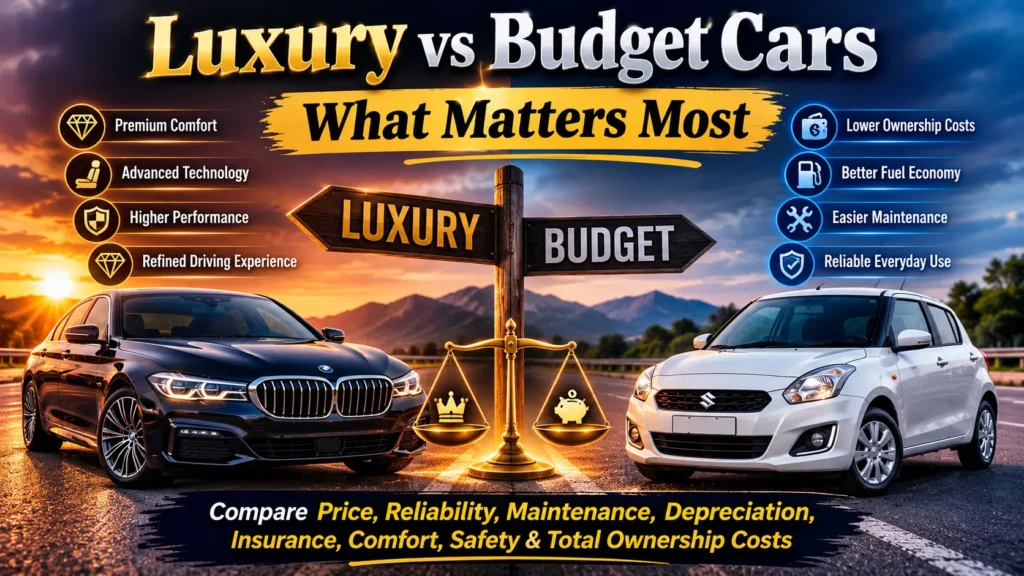
When comparing luxury vs budget cars, the smartest choice isn’t always the vehicle with the lowest price or the most impressive badge. What matters most is finding a car that fits your budget, lifestyle, driving needs, comfort preferences, reliability expectations, and long-term financial goals.
A budget car can be the better choice when you want affordable maintenance, strong fuel economy, predictable ownership costs, and financial flexibility. A luxury car may be worth the extra investment when you genuinely value premium comfort, advanced technology, performance, refined interiors, and an enjoyable driving experience.
Before making your final decision, look beyond the monthly payment and compare the total cost of ownership, including Depreciation, insurance, fuel, maintenance, repairs, financing, warranty coverage, and resale value.